My Blog List

Showing posts with label Damory Court. Show all posts

Wednesday, August 2, 2023

The Rives (Ryves) of Damory Court

Blandford Forum

In 1929, James Rives Childs of Lynchburg, Virginia published Reliques of the Rives (Ryves): being historical and genealogical notes of the ancient family Ryves of County Dorset. This book has been a mainstay for Reeves researchers; however, only a small portion of today’s Reeves’ families descend from this lineage. This Reeves (Rives) family is represented in Group 8 of the Reeves DNA Project which currently has twenty-five members with matching Y-DNA verifying their kinship.

Gravestone Inscription of
Robert Ryves
The Dorset family of Ryves descends from one Robert Ryves of Blandford County, Dorset, England who is the first of the name in England of whom there is record. He was born about 1490 and died 11 February 1551. Although the old church of Blandford Forum was destroyed by fire in 1731, an officer in the King’s Army in 1644 made notes describing the tomb of Robert Ryves. His grandson, Sir John Ryves, born 1536, in a petition stated that King Henry VIII had granted the premises of the manor of Milton County, Dorset to Robert Ryves in 1546.

Many family history books written and published long before the current level of access to historical documents contain abundant misinformation because they relied heavily on proximity as a source of family connections. Childs spend a great amount of time researching Reliques and the book appears to be factual except for a few errors that seem based upon data submitted by Reeves descendants, not the work of Childs himself.

At the time in 1929 when Reliques of the Rives (Ryves) was first published, Childs believed that the immigrant ancestor of this family was William Ryves who was a titheable in Surry County, Virginia in 1684 and 1695. After much further scrutiny and mounting inferential evidence in support of the theory, in 1957, James Rives Childs wrote an amendment to the book which was published in the Virginia Magazine of History and Biography.

During the years after the first publiation, Childs felt that based upon his subsequent research along with additions and corrections shared by others that the immigrant was more likely Timothy Ryves, born 1625, the son of Timothy and Mary Ryves of Oxford. Timothy Rieve or Rives' estate was recorded in the Charles City County Order Book for 1687-1695. He was the father of George, Robert, John, and Timothy Rives, of Virginia.

Recently a Reeves colleague who descends from this family shared a link to this book that contains many interesting tidbits that may be of interest to other members of DNA Group 8 and others of the Rives or Reeves family descending from this lineage.

A Genealogical and Heraldic History of the Landed Gentry of Great Britain By Bernard Burke · pub. 1900


Sunday, November 20, 2011

In Pursuit of Castles and Crests

What is it about the concept of our ancestors having been titled nobility with castles and crests that appeals to us so much that it overrides our intellect? Modern Y-chromosome DNA testing is revolutionizing genealogy by confirming and/or contradicting previously held theories of relationships and lineages. Yet amazingly, countless online GEDCOMs and family trees are still filled with the incorrect assumptions of years past before DNA tests were performed on descendants from these family lines. A review of the first 5 pages of Google results searching for Robert Ryves of Dorset produced 10 sites that appear to be truly descended from Robert Ryves through the Rives family which is documented by DNA with 29 more sites purporting to be descendants through lineages which have proven to be of another Reeves lineage. Online Reeves' family lineages abound with such pedigrees which have been proven, over and over, to be incorrect.

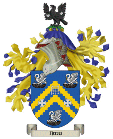
Reportedly a coat of arms was conferred upon Robert Ryves, courtier of King Henry VIII, in the first few years of the 16th century. The ancestral home of that Ryves family was Damory Court in Blandford, Dorset of the United Kingdom.

Eleven years into the 21st century, do we not all understand the absoluteness of DNA - that Y-chromosome DNA is inherited by male descendants unchanged except for occasional random mutations which occur over many generations? Surely there can be no question that with fourteen different groups or lineages identified by the Reeves DNA Project plus countless other Reeves individuals whose DNA does not fall into any of those groups, that only ONE of those lineages can descend from the Reeves or Ryves family of Dorset. It is categorically impossible for the descendants of a Reeves/Rives/Ryves male who lived in the 16th century to include multiple different DNA haplogroups and combinations of markers.


If we do all understand the scientific conclusions of DNA testing, then the obvious question looms - why do all the copious and completely different Reeves' family lineages continue to list Robert Ryves of Dorset on their pedigrees and websites? Are they uninformed, unintelligent or just otherwise misguided? Maybe not. The continuation of the practice of multiple Reeves' families linking to Robert Ryves as their ancestor appears to be simply that the desire to be descended from royalty supersedes intelligence, scientific fact, historical documentation and everything else.

The majority of the immigrants to the new world were certainly not wealthy or titled. They came for a myriad of reasons - religious freedom, as indentured servants seeking a chance to prosper in this new world or simply out of a desire for adventure. Prisoners of the British government were transported to the colonies as punishment for their political differences such as Scottish prisoners after their loss at the battle of Culloden.

Ironically, three hundred years after the first successful English settlement at Jamestown was established, most of the great estates and much of the English aristocracy, who were land rich but cash poor and whose income dwindled every year were seeking wealthy American brides. In the early part of the 20th century, the fabulously rich daughters of American billionaires such as Consuelo Vanderbilt traveled to England looking for a title and married into the cash strapped aristocracy. In 1895 alone, nine American heiresses married members of the English aristocracy, and by the end of the century a quarter of the House of Lords had a transatlantic connection.

American genealogy would benefit greatly if the descendants of the early colonists could begin to embrace the bravery and spirit of their less than royal ancestors. It took great courage to make the dangerous journey and endure the generally perilous living conditions of colonial America which should be admired and celebrated. The fact that they survived and prospered may have far more merit than a crest or a castle.