My Blog List

Showing posts with label Ashe County. Show all posts

Sunday, January 2, 2022

Heirs of Obedience "Biddie" Terrell Reeves

The children of Jesse Reeves (spelled as Reves by he and his male relatives) and Elizabeth Obedience Terrell of Grayson County, Virginia and later Ashe County, North Carolina have up until now been undocumented. Jesse Reeves names most of his older sons in his 1833 will but only two of his daughters by Biddie Terrell. None of his children with his second wife, Mary Bowers, were named. There has been much misinformation promoted about Jesse's children. The identity of the correct mother of each group of children was also questionable.

Several years ago in the course of transcribing Ashe County NC deeds by various members of the Reeves' family, I came upon an 1833 Power of Attorney by Jesse's son John Reves. In that POA, John requested that his cousin Enoch Reves appear on his behalf at a court in Wythe District, State of Virginia, where a case by he and the rest of the heirs of Biddy Reves was to be presented in court. When I read this POA, I realized that those court records would provide details of the heirs of Jesse Reves born during his marriage to Obedience Terrell Reves. At that point, I began to search for the records of that case.

The Library of Virginia had been diligently adding Chancery Cases to their online site but at the time they had not scanned either Wythe or Grayson county cases and put them online. Over the next few years I checked back periodically and was pleasantly surprised sometime during the last year, when I found they had been added. This case involves a suit filed by Jesse Reves' son George to recover legacies due the heirs of Timothy Terrell from his father John Terrell.
This Chancery Case revealed a previously unknown son of Jesse Reves, William, along with two daughters. There had been much speculation regarding the gravestone for Nancy Reeves in the Jesse Reeves cemetery in Ashe County. A theory had circulated that this was an early wife of Jesse but these documents found her to be Nancy who married Terrell Bledsoe and both are mentioned in numerous family documents and court records. Another daughter Hannah Reeves, speculated as another daughter of Jesse's brother William was revealed to be Jesse's daughter who had married John Burton and eventually migrated to Indiana where other Burton and Reeves' family members had settled.

A record dated 26 May 1829 discovered in Grayson County Court Orders Vol. 2 (1820-1829) on page 596 in a case styled George Reeves, Plts, Against William Terrell, Defts, names Hannah Reeves, wife of John Burton, Betsy Reeves, wife of William Cox and Nancy Reeves, who was deceased after having intermarried with Terel (sic) Bledsoe.

Several years of research of the various extant records of Grayson and Ashe counties have documented that the children of Jesse Reeves and Elizabeth Obedience Terrell were: Nancy who married Terrell Bledsoe, William, George who married Elizabeth Doughton, Hannah who married John M. Burton, Jane who married Robert Baker, Elizabeth who married William Cox, John Reeves who married Cynthia Baker and Eli Reeves.

This 61 page Chancery Case and the supporting records in Grayson County's court orders have been a great bonus to research of this family and served to rectify several incorrect theories that have become prevalent on the internet. The Library of Virginia is doing a great service in making these Chancery Cases available to Virginia researchers.

A complete listing of the currently documented descendants of George Reeves, Sr. of Grayson County, Virginia can be found at The Reeves Project.

Sunday, August 23, 2020

William Reeves & Mahala Goss

According to the 1860 census of Lee County, Virginia, William Reeves was born in Ashe County, North Carolina in 1824. The Reeves' family of Ashe County as well as Grayson County, Virginia are well documented and with one or two exceptions of individuals found there briefly in marriage records, appear to all descend from George Reeves, Sr. who settled on the Peach Bottom Tract of Grayson County in 1767. Much research of Grayson and Ashe has failed to locate any Reeves' family descending from George Reeves, Sr. to which this William Reeves might belong. His parentage is currently a complete mystery.

Ashe County, North Carolina
William married Mahala Goss shortly before 1850 for they were recorded in the 1850 census of Bennett Bayou, Fulton County, Arkansas with one year old Mary Ann. On the previous page in that census, the next residence in Bennett Bayou is a Jesse Reeves born 1822 but there is nothing to connect the two families other than a child with the surname Murphy in each household.

Census records record the birth of Mahala, at times called Hallie, in 1831 in Lee County, Virginia and that is where the family is next recorded in the 1860 census.  In the 1860 census of the Western District of Lee County, William, Mahala, Mary, another daughter listed only as M. S., Andrew Johnson "Jonce" and William Shelby Reeves are  listed.

Andrew Johnson
"Jonce" Reeves

The last record of William and Mahala Reeves is in Cumberland County, Tennessee in the 1870 census and by then Julia Ann, Rebecca Jane and Lucinda Reeves have been added to the family.  The last records of William Reeves  are two entries for land dated 7 Mar 1873.  One entry for 400 acres is located on Devil Creek and the other for 650 acres is on Meadow Creek, both are in Cumberland County.  

Several undocumented theories are that Mahala died by 1878, possibly in an institution, but there is nothing to support that theory.  Whether William Reeves was also deceased is unknown but he disappears from Cumberland County and the lives of his children before 1880.  

By 1880 the children had disbursed and were living in various homes where they appear to have been working for the families with whom they are listed.  In the 1880 census, Mary Ann "Polly" had married John Washington Welch and Andrew J. "Jonce" was living in their household and working for his brother-in-law in Cumberland County.  William Shelby Reeves (listed as Shelby) was living in a boarding house in Union County, Kentucky along with other young men listed as laborers.  12 year old Lucinda was listed as a servant in the household of farmer J. H. Officer in Putnam County; 16 year old Rebecca Jane is listed as Jane Reeves  keeping house in the household of Henry Watson in Overton, Tennessee; and 18 year old Julia is listed as house keeping in the residence of a Benjamin Watson also in Overton County. 

Much research has been done on this family in North Carolina, Virginia and Tennessee but at this point, there are no viable theories as to William Reeves' family origins.  However, Mahala is believed to be the daughter of John Goss and Abigail Osborne of Ashe County.  John Goss was the son of Zachariah Goss who is recorded as being hung as a tory by Colonel Benjamin Cleveland in Wilkes County, North Carolina in 1781.

The history of the New River area of North Carolina and southern Virginia records the tale of at least 3 Tory loyalists who were hung by Colonel Benjamin Cleveland in 1781.  There are numerous variations of the story online although none seem to have detailed documented information.  The 2011 post Hanging of a Loyalist named Reeves can be found on this blog where I provided all the information I was able to find about this story.  The 3 loyalists who were hung were Capt. William Riddle, Zachariah Goss and an as yet unidentified Reeves individual. 

For some time I have been puzzled as to whether this Reeves was a member of my own family who are connected with the Reeves family of George Reeves, Sr. of Grayson County as proven by Y-DNA, but to date, nothing has been found to document a connection.  Since there appear to be so many connections between William Reeves and Mahala Goss to the Goss and Reeves' families of Ashe and Grayson counties it seems a plausible theory that there is a connection to their family.

Anyone reading this post who descends from William and Mahala Goss Reeves and would like to help unravel the mystery, please consider taking a Y-DNA test at Family Tree DNA and joining the Reeves DNA Project.  Y-DNA testing requires a male with the Reeves surname since Y-DNA is passed through the male line unchanged for countless generations with the exception of an occasional random mutation.  Y-DNA is far more accurate for this purpose and provides results within about 6 weeks to accurately identify the Reeves lineage from which you descend. 


Thanks to William & Hallie's descendant Heather for the use of the above photo of her ancestor Andrew Johnson "Jonce" Reeves.

Saturday, July 14, 2018

Settlers in Kansas Territory

After the death of their father, Terrell and Gaston Reves settled in the new Kansas Territory as soon as it was opened for settlement. Their father William was one of the sons of George Reeves (Reves) of Grayson County, Virginia. William and his extended family had left Ashe County, North Carolina around 1822 and after a time in Indiana, eventually settled in Carroll County, Arkansas by about 1840. There William and these sons along with their brothers Lenoir and John were recorded in census and tax records. After William's death sometime between 1840 and 1850, various members of the family are recorded on the tax lists of Independence County, Arkansas throughout the 1850's along with another brother, William H. Reves, who was a Baptist minister.

Excerpt from 1866 Map of Kansas
Gaston Reves along with his oldest sons Albert and Moses (Mack) were listed on the tax lists of Independence County in 1854 which was the final record for members of Gaston's family in Arkansas. The History of Verdigris Township in Historical Atlas of Wilson County Kansas records that "Gaston Reeves and his son Max (sic Mack) took claims in the spring of 1857".

Terrell Reeves was recorded on the 1856 tax lists of Independence County which apparently preceded his migration to Kansas for the history of Greenwood County, Kansas lists the Pleasant Grove township as being established in 1856 by Terrill Reeves.

In those early years of Kansas' history, besides indian attacks, there was also great political unrest involving guerrilla warfare as the debate over the expansion of slavery led to violence in Kansas. The bad weather, bad crops and destruction of crops and property by the opposing forces often offset the sense of prosperity that had fueled the rush of settlers to the newly opened territory. A large number of settlers left the territory after the bitter winter of 1856 and many experienced starvation effecting themselves and their animals caused by a severe drought in 1860.

Bill for coffin of Gaston Reves son of Terrell
The records do not reveal the causes of their deaths, but over the next five years, Terrell and three of his sons as well as his brother Gaston and his oldest son Albert were deceased. Terrell and his 21 year old son Gaston both died on the 4th of May, 1859 but the probate documents give no clue as to the cause. Although no probate documents have been discovered for his brother Gaston, all of his children were orphans living in the home of A. Venard, a probate court judge in Greenwood County in the 1860 census. Over the next decade the majority of the rest of the children from both families had also died.

Although I never doubted that pioneer life was hard and extremely dangerous, researching the story of these young families and their westward migration which ended so soon after their arrival in southeastern Kansas Territory has both surprised and saddened me. Even as my various families migrated out of Virginia and North Carolina into the wilderness that existed in early Kentucky, Tennessee and other newly formed states, I had just never discovered such hardship and death.


See post in this blog about William Reeves of Grayson County, Virginia and Ashe County, North Carolina

Tuesday, December 26, 2017

New Data on George Reeves of Grayson County

Blue Ridge Vista in Grayson County
After searching for a decade for the source of a very old 1999 post on the Reeves Genealogy.com forum regarding the statements by a Mrs. Helen Trent Hobbs in regard to the origins of George Reeves who settled in Grayson County, Virginia in 1767 I have finally found the answer. An Ancestry post to the page of a distant Reeves' cousin contained a portion of the statement with a clue as to the name of the book and its author. The statements were from a letter written by 86 year old George W. Reeves of Ashe County, son of John Reeves, which were included in a 1951 volume published by LeRoy Reeves, a descendant of Edward Reeves of Bladen County, North Carolina.

The book is entitled Ancestral Sketches - Ancestry of William P. and Peter M. Reeves and contains a wealth of information regarding early Reeves families in North Carolina. It is a great shame that LeRoy Reeves did not have access to the historical records currently available and the added blessing of Y-DNA results. He has done an excellent job in researching these families and attempting to find possible familial relationships. The passage quoted from George W. Reeves' letter contained the following:
In December, 1897* (sic) George W. Reeves of Jefferson, Ashe County, North Carolina, then almost 86 years of age, wrote: "My grandfather's name was George Reeves whose birthplace I am unable to give, but was principally raised in eastern North Carolina. He was born about the year 1704 or 1705 (sic) and came from Neuse River, N.C., to New River, Grayson County, Virginia, about the year 1725 (sic) bringing his wife with him. They had born to them seven daughters and four sons, the youngest of which was John Reeves who was my father. When my grandfather came to Virginia no others of the Reeves family came with him, but my recollection is that he left others of the Reeves family in eastern N. C. whose names I am unable to give. But well remember my father had two cousins, William Reeves and Jeremiah Reeves, who visited my father since my recollection. I also remember that my grandfather's family frequently visited their relatives in eastern N. C, and I am sure that my grandfather left brothers and sisters in that part of the state...My grandmother's maiden name was Jane Burton."
Finding the source of these statements by George W. Reeves has been a complete thrill and further confirms the family connection between William Reeves of Wake County, North Carolina and George Reeves of Grayson County, Virginia that was discovered when descendants of both participated in the Reeves Y-DNA Project. It also should put to rest any lingering belief in the debunked theory (see posts in this blog) that the wife of George Reeves of Grayson County was a daughter of Joshua Epps of Halifax County, Virginia since George W. Reeves was obviously knowledgeable of the fact that his grandmother was Jane Burton.

I also found the remembered visit by his father's cousins, William and Jeremiah, of particular interest since two of the younger sons of William Reeves, Jr. of Wake County, North Carolina, by those names had migrated to Madison County, Kentucky with their father which would have been in relative close proximity. Any trip they would have made back to their previous home in Wake County would have taken them through the New River area of Virginia.

LeRoy Reeves speculated in his book on possible connections between George, William and Edward Reeves of Bladen based upon their arrival in the eastern portion of North Carolina at about the same time. He collected a tremendous amount of census and land records for the early Reeves of North Carolina but by not being privy to Y-DNA the majority of his proposed connections have been proven to be unfounded and to have been primarily based solely on proximity. The Reeves Y-DNA Project has no record that any descendants of Edward Reeves of Bladen County have ever participated so we aren't able to confirm any family connections. For the sake of adding more authenticity to Reeves genealogy, we'll have to hope that eventually some of those Bladen County NC Reeves' male descendants decide to participate in the DNA project.

In the meantime, I'll just continue to bask in the joy of finding the published information from George W. Reeves' letter.


* Note that the date the letter was written appears to be in error since George W. Reeves died in October of 1896 according to the inscription on his gravestone pictured at Find A Grave. George W. Reeves was born in April of 1812 and he would have been almost 86 in December of 1895, not 1897 which appears to have been a transcription error.

UPDATE:  Since this post was originally published, two descendants of Edward Reeves of Bladen County, North Carolina have now participated in the Reeves' DNA Project.  Neither is a match to other Reeves in North Carolina and they are the first members the new DNA Group Nbr. 22 at FtDNA. 


Tuesday, May 17, 2016

Mary Reeves Doughton

The family of Mary called Polly, daughter of George Reeves of Grayson, Virginia, who married Joseph Doughton has been a mystery since there are no probate records for Joseph who died in 1832 in Ashe County, North Carolina. Documenting their children has been a futile effort until I recently discovered that Ashe County, North Carolina's Register of Deeds has put scans of their deeds back to 1799 online. In many instances, deeds are about so much more than the sale of land and in this particular instance, these Ashe County deed records are a gold mine of genealogical information.

In Deed Book V there are three deeds by the heirs of Joseph Doughton which provide the names of their nine children who lived to maturity. In each of these three deeds, the heirs were selling a tract of land to another of the heirs - Jesse Doughton, Charles H. Doughton and George Reeves, son-in-law and husband of daughter Elizabeth Doughton.

These deeds not only document the children of Mary Reeves and Joseph Doughton, they give the names of the husbands of those daughters who had married by 1832 when Joseph died. David Cox, John Cox McGimsey, Denny Robinson and George Reves are identified as the husbands of daughters Jane, Charity, Polly and Elizabeth. The deeds provide as much documentation of the family members as a will would have.

Heirs of Joseph Doughton to George Reves
Ashe County NC Deed Book V, page 268
Heirs of Joseph Doughton to George Reves
Ashe County NC Deed Book V, page 269
According to family legend, Joseph Doughton is believed to have been a member of an early surveying team in the New River area. He contracted typhoid fever and was taken in by former Revolutionary soldier Lt. George Reeves who had settled along the New River in 1767. As the story goes, Joseph was nursed back to health by George Reeves' daughter, Mary. During his convalescence, they fell in love and were married.

Joseph Doughton was recorded as a justice of the Ashe County Court by 1806 and in 1817 served as a representative from Ashe County to North Carolina's House of Representatives. Descendants of Joseph and Polly Doughton continued the family's public service - Rufus Doughton would later serve as North Carolina's Lt. Governor and Robert Doughton as a U.S. Representative.

Thanks to these wonderful deeds by Joseph Doughton's heirs, we now have documentation that their children were Irena Jane Doughton Cox, Elizabeth Doughton Reves, George H. Doughton, Grace Doughton Phipps, Charles Horton Doughton, Charity Ann Doughton McGimsey, Jesse Doughton, Polly Doughton Robinson and Rosamond Doughton Lewis. There also appears to have been another child, Joseph Doughton born about 1794, who died before reaching maturity. Although undocumented he is listed in several sources and the 1810 census of Ashe County lists a child that age in Joseph and Mary's household.

Tuesday, March 1, 2016

More Reeves' Signatures

As I have continued to collect scans of original documents primarily for their signatures, I have numerous signatures for the Reeves (Reves) families of Wake County, North Carolina and Grayson County, Virginia/Ashe County, North Carolina. These families share matching Y-Chromosome DNA but currently no paper trail has been located to explain the connection. Currently proximity is one of the few commonalities, both William Reeves and a George Reeves who appears to be the same individual who settled in the New River area around 1767 were recorded in the deed and court records of Orange and Johnston Counties circa 1760. The other major commonality is that the male members of these families were all literate and consistently signed their names as REVES, not with the double "E" used by later generations.

Included here are various documents signed by William Reeves of Wake County NC and his sons as well as the sons of George Reeves of Grayson County VA.

Signature of William Reves (c1740-1821) of Wake County, North Carolina from his answers to interrogatories in depositions taken in the court case of David Daniel vs. the executors of Woodson Daniel.


The signature above is that of Peter Reves, son of William Reeves (Reves) of Wake County NC. Peter, along with his brother Charles, moved a short distance into Halifax County, Virginia around 1800. This acknowledgement signed by Peter Reves in 1851 is part of an application by Elizabeth Brown Neal for a Revolutionary War pension based upon her husband Thomas Neal's service. Elizabeth Neal's statement was made to Peter who was the Chairman of the Halifax (VA) County Court.

Madison County, Kentucky consent for the marriage of his daughter Elizabeth signed by Jeremiah Reves, one of the younger sons of William Reeves. Elizabeth Reves married a Jefferson Reves whose identity is unknown. Jefferson was likely a cousin of Elizabeth's, possibly the son by that name of her uncle John Reves of Wake County NC who disappeared from the records there around 1837.


Above document is the 1802 Madison County, Kentucky marriage bond for George Reves, the son of William Reeves of Wake County NC, to Elizabeth "Betsy" Wilkerson.


1811 Note to James Cox for $133.00 signed by Jesse Reves of Ashe County, North Carolina, another son of George Reeves of Grayson County, Virginia.


1809 Power of Attorney by George Reves, Jr., son of George Reeves of Grayson County VA, to Robert H. Burton to act on his behalf in a court case in the Ashe County Superior Court.


Bond by William Reves, son of George Reeves of Grayson County, Virginia, and his son-in-law Allen Burton for John Reves, Jr. and William's wife Ann Reves. This court case, Landreth vs. William Reves, was filed around 1813 and was still active as late as 1822. The John Reves, Jr. named in this bond is most likely the son of William Reves of Ashe who was born circa 1795. It was a common practice in early America to differentiate between individuals of the same name by identifying the younger person as Junior not necessarily because the individual named as Senior was their parent.


Although the above is not a scan of the original document, the signatures as published appear to be taken from scans of the original document. The signature of Wm Reves on this 1761 Orange County, North Carolina deed would undoubtably be that of William Reeves, Sr., the probable father of both William Reeves of Wake County and George Reeves of Grayson.

There are many more documents signed by these individuals and others as well as later generations using the Reves spelling of the surname but eventually most of the family began to use the more common Reeves variation of the name. As yet I have been unable to find other Reeves' families who spelled their name in the same manner. It would be a great help in locating the family's origins if we can eventually find others using the Reves name.

Sunday, November 4, 2012

The Wayfarer - William Reeves of Ashe County


William, the son of George Reeves of Grayson County, Virginia, and most of his children left Ashe County, North Carolina shortly after 1820. Based upon estimates of his age from census, he would have been around 55 years old at the time. He was a justice of the Ashe County court and appears to have been prominent in the community, but for whatever reason, he left North Carolina and ventured to the new state of Indiana. By 1822, William was listed on the Lawrence County, Indiana poll tax list. Once William left North Carolina and began to migrate westward, he seems never to have stopped moving.

1829 Land Warrant in Greene County, Indiana to William Reves
1829 Indiana Land Grant
to William Reves
In the years preceding William's departure from the New River area of Virginia & North Carolina, his father had died in 1811 as well as his brother George Reeves, Jr. George Reeves, Jr. was killed by his brother-in-law William Tolliver, husband of sister Susanna Reeves. The trial was held in Wilkes County and there are various theories but the actual cause of the incident still remains unknown. Beginning around 1813, there was another court case, Landreth vs. Reves, which continued over a lengthy period with documents in the court records as late as 1822 in regard to it. There are numerous documents in the Ashe County Civil Action Court files regarding this case although there is no clear explanation of the events that precipitated the court case. From various documents, John Landreth states that he had been accused of perjury by William Reves although there is no exact explanation of the nature of the accusation. It would appear from these documents that the entire extended Reeves' family, even William's wife Anne Terrell Reeves, became involved in a fracas which resulted in the issuance of a summons. Oddly, members of both the Tolliver and Landreth families also migrated to the same area of Indiana in the 1820's.

William Reves' bond in Landreth case
1816 Bond by William Reves and
Allen Burton for John and Ann Reves
Whether the unpleasantness of the death of his father, the murder of his brother or the Landreth court case played a role in William Reeves' decision to leave Ashe County is unknown, but following these events, the family began the first of their migrations. They settled in the area of Greene & Lawrence Counties where they remained until sometime before 1840 when they are found in the census of Carroll County, Arkansas.

From: History of Greene County, Indiana, pub. 1870 by J. Ward, Worthington, Indiana - As taken from the official records, and compiled from authentic recollections by pioneer settlers. Chapter XV - Beech Creek Township: Among other pioneers whose name deserves a place in the history of the township, may be mentioned...William and Noah Reeves...Pg 47 - William Reeves and his boys first settled the farm now owned by Edward Walker.

Between Indiana and Arkansas, the Reeves' family must have spent some time in Missouri probably in the area of Washington County. William's son Albert married there in 1837. Lenoir (Noah) Reeves was also living in Missouri briefly for several of his children were born there before he ventured briefly to Arkansas, Iowa and Nebraska then eventually to Oregon, dying there in 1888. Both Albert and Timothy settled in the area of Iron and Butler Counties in Missouri.

Missouri Ann Reeves, daughter of Timothy Reeves
Missouri Reeves Emmons
daughter of Timothy Reeves
By the Census of 1840 for Carroll County, Arkansas, William along with his sons John, Terrel and Gaston Reeves are listed. The 1840 tax list for Carroll County lists Lenoir, William, Terrel and John Reeves. They, along with Gaston, are also listed in the 1841 tax lists for Carroll County. Located near the headwaters of the Buffalo River in Van Buren Township in Carroll County there is a Reeves' Creek which is said to have been named for this Reeves' family.

The 1841 tax list appears to be the last historical record of William Reeves. Several family trees list a date of death of 1854 in Missouri but no documentation can be found in support of that theory. It is likely that William, and his wife Anne as well, died in Carroll County between 1840 and 1850 when most of his sons are found in the census of Independence County, Arkansas.

Descendants of William Reeves' brothers Jesse and John have participated in the Reeves DNA Project and been placed in Group 6. A descendant of George Reeves, Jr.'s son Enoch, also a participant in the Reeves DNA Project, has been placed in Group 14 with a descendant of George Reeves whose paternity is currently unknown but may be the son of Jesse. Whether these are NPEs (non paternity events) is unknown and more extensive research is needed to resolve this mystery. Hopefully at some future time, descendants of William Reeves will participate in DNA studies, either Y Chromosome DNA or the new autosomal DNA projects that are now available and help to clarify this lineage.

Other posts in this blog pertaining to the family of George Reeves of Grayson County, Virginia:

George Reeves of Grayson County, Virginia
Who really are the descendants of Henry Reeves?
Col. Timothy Reeves, CSA
The Reeves' Gang
Episode 2 - More of the Reeves Gang
Pewter John Reeves Stamper

Sunday, August 12, 2012

Col. Timothy Reeves, CSA

Letter to Gen. MarmadukeCol. Timothy Reeves (he signed his name as Reves), was the youngest son of William Reeves (Reves) and Anne Terrill of Ashe County, North Carolina. William's father was George Reeves of Grayson County, Virginia, a soldier of the Revolution.

The internet has numerous sites with various references to Col. Timothy Reeves, commander of the 15th Missouri Cavalry of the confederacy. He is referred to as both a devil and a saintly hero depending on each individual's point of reference - he was a baptist minister and a ruthless military commander. The determining factors seem to be based upon Civil War sympathies.

He was present and had preached at the gathering held on 25 December 1863 at Pulliam's Farm in Ripley County that is recalled as "The Wilson Massacre". Union forces under Major James F. Wilson made a surprise attack during a Christmas dinner gathering killing 35 confederate soldiers along with 60 civilians including women and children, families of the confederate soldiers and neighbors. Col. Timothy Reeves is said to have commanded the Confederate forces who began immediate reprisals against the union forces which culminated in the execution of Major Wilson.

Col. Timothy ReevesAfter 150 years the validity of this story and whether the massacre did indeed take place is still hotly debated on countless websites. The complete truth of the incident will probably never be known, but there is much evidence to support the belief that the event did take place. There are even references to it carved on some confederate tombstones in the Ripley County area.

His brother, William, also a baptist minister as well as his adjutant in the 15th Missouri Cavalry, may have died during the war for there is no historical record of him afterward.

In May of 1865 Confederate General M. Jeff Thompson surrendered 10,000 men at Jacksonport, Arkansas. Out of those 10,000 men, only one was not paroled - Confederate Colonel, Timothy Reeves, Commander of the 15th Missouri Cavalry, CSA. Thompson wrote that:
"In a few days we finished all the paroles, except that of Timothy C. Reeves, whom Col. Davis would not agree to parole, considering him outlawed for the shooting of Major Williams (Major Wilson, this was a misprint) and five men on the Price Raid; but I must state for Col. Reeves, that he was as good a man and soldier as any in the command, and his shooting of that party was entirely justifiable.."
From all accounts Timothy Reeves lived the remainder of his life in peace, preferring to be known only as a minister. When he died on March 10, 1885 three wives and most of his children had predeceased him.


Sunday, June 10, 2012

Episode 2 - more of the Reeves Gang

The following is a passage from Spencer Elsworth's Records of the olden time; or, Fifty years on the prairies. Embracing sketches of the discovery, exploration and settlement of the country, the organization of the counties of Putnam and Marshall, incidents and reminiscences connected therewith, biographies of citizens, portraits and illustrations, Lacon, Illinois pub. by Home Journal Steam Printing Establishment, Page 532. This version of the story of the Reeves Gang provides much more information and a background to the family's history before arriving in Iowa which was the basis for a prior posting.

Information contained in this and several other histories of this area of Illinois suggest that George was the son of William Reeves rather than his brother Jesse; however, that doesn't appear to be possible based upon the ages of male children in William Reeves household in census of 1800 and 1810. George Reeves also did not leave the New River area in the early 1820's as did William Reeves and his sons. George left Ashe County in the mid 1830's which would coincide with the death of Jesse Reeves.

Reeves the Outlaw
The frontier settlements of a new country are usually the resorts of desperadoes. The law has fewer restraints, and men fleeing from the consequences of crimes go where they are unknown and unsuspected some to grow up respectable, law-abiding citizens, oftener to ply their nefarious business and prey upon society with less fear of detection. Among old settlers Geo. Reeves possesses an unenviable notoriety by reason of his connection with the well known Bandits of the Prairie, an association of desperate men extending over the then entire West.
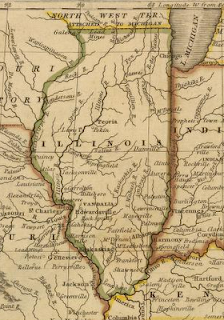
Illinois 1832Previous to his removal here in 1833-4, he lived a while in Senachwine Township, where his brothers had made claims, and where so far as known he conducted himself inaccordance with the strict principles of justice and right. He was a kind neighbor, scrupulously just in his dealings, ever ready to accommodate, and kind in sickness. At this time he was about forty-five or fifty years of age, suave and gentlemanly in appearance, seldom excited or thrown off hisguard, and prompt to repair an injury or accommodate a neighbor.

Of his previous history little was known, except that he came of a respectable family in North Carolina, where he had led a wild life and was connected with dissolute fellows of whom no good could be said. A murder had been committed by the gang, and though it could not be proven that Reeves was directly implicated, he was detained in prison a long time, and only escaped by strenuous exertions on the part of his friends, and the expenditure of much money. After his liberation he started for Illinois, and is believed for some time to have conducted himself with strict propriety, but bad habits are stronger than good intentions, and it is probable his old associates sought him out in the West and tempted him to his downfall.

The Reeves family consisted of himself, wife, four sons and one daughter, the latter a young lady of more accomplishments than might be expected under the circumstances of her education. The children, if we may believe a neighbor, were systematically trained to steal. The old lady claimed all the eggs about the premises as her personal perquisite, and the old man, under the plea of wanting them for his bitters, used to hire his son George, termed the "General," to steal them from his mother. Sophronia had many friends in Henry and was much thought of. Mrs. Reeves was a Dowton, and connected with the Harts, a disreputable, thieving set, living in the timber across from Henry. She was the ruling spirit of the family, and its evil genius. She encouraged her sons in idleness and secreted their plunder. It is probable the point selected for their new home was chosen as a safe retreat for the nefarious end in view. It was far away from the settlements, and situated in the mouth of a deep ravine, into whose dim recesses the sun seldom penetrated. Its precipitous sides and center were covered with brush, there were lateral branches extending on either side, affording admirable chances for concealment, while the main hollow opened on the prairie a couple of miles or more westward.

Reeves had several cabins or outhouses on the premises fitted up for lodging rooms, and first attracted attention by the frequent appearance of strange faces about his establishment. For some time the gang with which he was connected worked secretly and successfully. Horses stolen on Rock River were brought here to be disposed of, while those stolen here were swiftly taken abroad. By this time (1842) the country was rapidly filling up, and a long course of successful crime had made the perpetrators reckless. Numerous burglaries and much petty thieving had been going on, directly traceable to Reeves' son. Among others who frequented the place were Burch, Fox and Long, the afterward murderers of Col. Davenport. Burch was a desperado, and the hero of more than one robbery, and, as is believed, murder. He was the intimate friend of Cam. Reeves, the eldest son of the old man, now blossoming into a first class thief and desperado. Himself and associates were detected in stealing and passing counterfeit money, and Mrs. Reeves had passed counterfeit money at the stores in Henry and Lacon, which her husband redeemed when called upon. The gang operated at other places. Horses were stolen at Tiskilwa, at Princeton, Toulon, and in Peoria County, and when the perpetrators were caught, confederates bailed them out or aided their escape. A store at Hennepin was broken into about this time, and the robbery was traced to Reeves' son, Cameron, and a young man named Allison. The parties were arrested near Pekin, and the goods found in their possession, but through the aid of a sharp attorney, of Peoria, they managed to escape.

Frederick Rheinbeck's house in Whitefield was broken into, and a party stopping there robbed of cash and valuable papers, which circumstance so wrought upon the community that a spontaneous and universal determination was reached to rid themselves of the presence of the offenders without waiting the forms of law. At this date it cannot be told who were mainly instrumental in bringing the parties to merited punishment, through Dr. Swanzy and J. S. Taliaferro, of Bureau County, were active participants. It was one of those risings when the whole community was ripe for action, and leaders were not necessary. A committee was sent to notify Reeves and request his attendance the next day, at a place on the prairie since called Council Grove, and found him conveying provisions to his son, known to be hiding from the officers in the bottoms above Henry. The old man took the matter quietly, but Mrs. Reeves raved like an enraged tigress. The next day some 300 men assembled. They came riding in from twenty to thirty miles distant from Stark, Bureau and Peoria Counties, with twenty men from the vicinity of Tiskilwa, headed by Dr. Swanzy, determined to deal out Rock River fare; in other words, extermination. Prompt to the time came Reeves on horseback, with old-fashioned saddle bags packed as for a journey. The meeting was organized by appointing Hall S. Gregory to preside. Dr. Swanzy led off with a speech, in which he recounted the crimes of Reeves and his gang, and urged the extermination of the whole tribe...Dr. Boal replied, advising moderation, and giving Reeves time to settle up his business,etc...Dr. Temple, of Chillicothe, replied to Dr. Boal, advising a middlecourse, and the appointment of twelve persons to take Reeves in charge and send him and his family out of the country. A majority of the company endorsed this action.

...Dr. Temple, of Chillicothe, replied to Dr. Boal, advising a middlecourse, and the appointment of twelve persons to take Reeves in charge and send him and his family out of the country. A majority of the company endorsed this action. When Swanzy spoke a rush was made for Reeves, and he would have been shotdown like a dog, but the chairman shielded him. Mrs. Reeves and children cried and begged for mercy. Reeves assented to the decision, and when he found his life was to be spared, seemed the happiest man there.

The party, led by the committee, went to Reeves' house, where arrangements decided on were carried out. Purchasers were found for the stock, and household property of value was quickly loaded on to wagons. When ready for a start, Mrs. Reeves went to the rear of the fire-place, and removing abrick, took therefrom a purse of money, and secreting it about her person, mounted the wagon with her family and were driven off. As the last finale of the tragedy, a coal was applied to the house and outbuildings, and the burning ruins lighted the self-appointed ministers of justice on their way.

The party was conducted to the river and kept under guard until the arrival of a steamer from above, when they were placed on board and warned never toreturn as they valued their lives. Cameron Reeves was captured that night and placed in the Hennepin jail, but escaped and left the country. The party proceeded down the river, and subsequently went up the Missouri and settled a mile and a half from Cameron, where they remained a short time and then migrated to Adair County,Iowa, where the old man died in 1852. He became much dissipated in his later days and died in poverty. George Dent speaks of meeting him once while passing through the state. He came to a camp fire around which the party was gathered, and when he left a particularly fine hunting knife disappeared also.

The lesson so sternly administered had good results. Of the family history for some years we have no data, but the younger members were among the earliest settlers of Omaha, and Cameron Reeves was the first Sheriff of the County. It is on record that he made a very good officer. During his term of service three men were taken by the vigilantes from the jail and hung. He married a very good woman, who has raised a respectable family. His two failings were a love of drink and women, and he is now living with one not his wife and principally supported by her labor, having separated from his lawful spouse.

Preston Reeves lives fifteen miles from Omaha, wealthy and respected and has raised a fine family. Jesse, the third son, died six years ago. He was well-to-do and raised a respectable family, but was given to drinking. George, the youngest, died of dissipation. He was a man of bad repute and was supported by a woman of the town. Sophronia is wedded to A. D. Jones, the founder of Omaha. He laid out the town and was its first postmaster. She is wealthy and respected, and moves in the first society.

Mrs. Reeves still lives (November, 1879), and resides with her daughter. Her life is above reproach, and she is a noted mid-wife and doctress.

Thursday, February 23, 2012

Pewter John Reeves Stamper

There are numerous sites on the internet with discussions and opinions regarding the origins of John Stamper who migrated to Carter County, Kentucky from North Carolina. The countless conflicting theories speculating on John Stamper's parentage are far more than there is room to relate on this post. Here are a few of the hypotheses found on this subject:

Eastern Kentucky - Carter County
Some published genealogy records report James W. or John Stamper as a half-Cherokee Indian reportedly fathered by a Cherokee Indian and a Reeves woman, either Agnes Reeves or Agnes' sister. (Who is Agnes Reeves? None of the websites espousing this theory identified her.)

John's birth name was James W. Stamper and James himself took the name "John". This same John was also known as "Pewter John Reeves Stamper".

A notarized affidavit by a descendant, Vernon J. Mead, in December 1983, shows John as a son of a Cherokee Indian.

Stamper genealogy lists a James W. Stamper (John) as the son of Richard Stamper and Martha Carter of Wilkes County, North Carolina.

One story relates that John was the offspring of one of William Stamper's sisters, possibly named Joanna. A Joanna Stamper lived in the Ashe County, North Carolina/Grayson County, Virginia area, and many Stamper researchers believe she was the sister of William and Thomas Moore Stamper. She married a Perkins.

Richard and Martha Stamper were possibly adopted parents who took him in when the out of wedlock birth to a Cherokee father and a Stamper mother occurred.

John seemed to have been a counterfeiter of coins, making silver coins out of pewter. He therefore had the nickname of "Pewter John".

Prior to locating in Kentucky, John's history is sketchy and questionable as many reported "facts" are conflicting. His birth has been variously reported in either February, September or December of 1800, in Ashe, Swain or Cherokee Counties, North Carolina.

The facts that don't appear to be contested regarding John Stamper are:

Grave of Sarah Stamper in Carter County, KentuckyHis marriage license and marriage bond were recorded in Floyd County, Kentucky, as John Stamper in Book 1, page 127 and Book 1820-2, page 24, respectfully. On 8 Jun 1820, he married Sarah Stamper, who was presumed to be his first cousin.

He was born about 1799, according to an Ashland Independent Newspaper dated June 22, 1882, that lists John's death at age 83, at the home of his son-in-law, Ezekiel McGlone, Buffalo Valley, Carter County, Kentucky.

John is buried at Bethel Cemetery, Olive Hill, Carter County, Kentucky, but his monument is now degraded and unreadable.

And finally, to put to rest the speculation that his father was a Cherokee Indian, the DNA of a descendant of John Stamper is a genetic match to the descendants of the Reeves' family of Grayson County, Virginia and Ashe County, North Carolina, and additionally to their Reeves' relatives in Wake County, North Carolina. Based upon DNA, Pewter John Reeves Stamper was the child of a Reeves male and an unknown female, possibly from the Stamper family. From the fact that John himself added the "Reeves" to his name, it could probably be assumed that he was aware of the family connection.

(Thanks to Anna Fultz Braun, Stamper descendant, for the use of her photo of Sarah Stamper's gravestone.)

Friday, February 10, 2012

George Reeves of Grayson County, Virginia

It was previously believed that George Reeves who settled in the New River area of Virginia and North Carolina around 1767 was descended from Henry Reeves of Essex County, Virginia through his son Thomas and came to the New River area from Chesterfield County, Virginia. After DNA tests on several of the descendants of George Reeves matched descendants of William Reeves of Wake County, North Carolina, research of that area has produced numerous deeds and other court documents which appear to pertain to this George Reeves.

There are countless Johnston County deeds circa 1762 to 1765 with references to both George Reeves and Richard Burton, believed to be the father of Jane Burton Reeves, such as: Richard Burton, Johnston County, to Samuel Peek, Buckingham Co, Virginia, 314 Acres in Johnston County, the plantation whereon said Burton now lives beginning at Wm. Reeves corner red oak on the bank of Neuse river, running thence on his line S23½Âº W crossing Ellobies creek several times 98p to his corner pine: S23½ W 160p to a corner pine: S65 E210p to a pine: N24 E184p crossing Gut several times to a blazed White Oak on Neuse River, just above the mouth of said Gut: up said River by several meanders to 1st sta…houses, orchard &c…Ann Burton∗ wife to Richard Burton examined privately by Lod. Tanner Esq. Wit: John Alston, Thomas Webb, Wm. Bradford, Johnston County, October 13, 1763.

The exact family relationship between George Reeves and William Reeves of Wake County is currently undocumented but the genetic match is close enough that they may have been brothers. Among the many details that connect these two families is their use of the name REVES rather than the many other variations - Reeves, Reaves, Rives. William Reeves and his father William, Sr. both signed their name "Reves". George Reeves of Grayson County, Virginia and his heirs also used the Reves spelling of the name. In subsequent generations, many descendants of both families changed to the more commonly used spelling of Reeves while some descendants maintained the original spelling of Reves.

It appears as though both Richard Burton and George Reeves sold their property in Johnston County around 1765 which would coincide with the appearance of both men in the New River area around 1767. Additionally a Johnston County court order of July 15, 1766 wherein Timothy Shaw was replacing George Reeves as overseer of the road would presumably be a result of George Reeves' removal from Johnston County.

From The Virginia magazine of history and biography, pub 1922 by the Virginia Historical Society - "...It was originally surveyed in 1753 for Peter Jefferson, Thomas and David Meriwether and Thomas Walker. It was the Peach Bottom tract. John Cox settled there the same year. George Collins and George Reeves settled there in 1767."

In George Reeves' deposition for Beavins (Blevins) vs. Newell — O. S. 174; N. S. 62 — Bill, 27th September, 1805, he stated that he was present in the New River area as early as 1767.
George Reaves was on the 1771, 1772, 1773 and 1774 tithables lists of Cornelius Roberts in extinct Fincastle County, Virginia.

He appears on the 1787 tax list of Montgomery County with 100 acres. In 1789 he was living in Grassy Creek/Fox Creek area of Grayson County near Daniel, Elisha and John Blevins, Robert Osborne and Ezeiel Young. The New River area changed state and county designations several times and by 1793, George and his son, Jesse, are listed in the tax lists of Wythe County, Virginia.

As George "Reaves", he received a grant for 200 aces on the waters of the New River in Montgomery County on May 18, 1796 and another for 100 acres on the north side of that river adjoining his own line on the west on May 30, 1796.

The children of George and Jane Burton Reeves were Jesse, William, Anne who married Bartholomew Austin, Mary who married Joseph Doughton, Susanna who married William Tolliver, George Jr., Lucy who married David Cox, Jr., Prudence who married Andrew Cox, Charity who married Zachariah Osborne, John and Elizabeth who married Samuel Phipps.


∗ The wife of Richard Burton was previously believed to be Mary; however all records for Richard Burton prior to around 1765 list his wife as Ann. In Apr 1765: Exhibited into court, a sale and inventory of the estate of James Farmer, decd, by Mary Burton, Executrix. Recorded in Johnston Co, NC County Court Minutes. Research by Burton Family researchers indicates that Ann Burton died sometime before 1765 after which Richard Burton married Mary, the widow of James Farmer who had died in 1761 in Johnston County.

The family of George Reeves, Sr. at The Reeves Project

Other posts in this blog about George Reeves of Grayson County, Virginia

New Data on George Reeves of Grayson County
Wilkes County's George Reeves Mystery
The Rest of the Story
Another Episode of the Epps Wife Fantasy
More Reeves Signatures

Saturday, January 21, 2012

The Reeves Gang

Preston ReevesIn the course of researching the descendants of George Reeves of Grayson County, Virginia and more specifically his son William who left Ashe County, North Carolina circa 1820 migrating to Greene County, Indiana and later to Arkansas, I came across the story of "the Reeves gang" in various Iowa histories. Lenoir Reeves, often referred to as "Noah" is mentioned in these stories along with a George Reeves. Lenoir is believed to be a son of William Reeves. Although no irrefutable documentation can be found, there is a large amount of evidence to support this family association.

The following version of the story of the Reeves gang is found in Iowa History at the IAGenWeb Project:
...The Reeves family was suspected of being connected with the gang of horse thieves that were doing so much work in Polk county, and a mob of citizens went to the Reeves home and gave them orders to leave the country under penalty of severe punishment if they refused to go. Then the family moved to Fort Des Moines from their home in Linn Grove on the North River. There were two old men and several grown sons in the Reeves family.

The Reeves family had not lived in Fort Des Moines long when Cameron Reeves killed James Phipps. The citizens of North River heard of it, and fearing that some trouble would arise over it they took upon themselves the trouble of forcing them again to move. Cameron had been placed in jail at Oskaloosa, so he escaped the visit of the mob. The remaining family were visited one day by about sixty men and were again told to leave the country. When the mob was approaching, Presley Reeves saw them and thought that be would make a run for liberty, and started across a corn field. He was captured in a short time and brought back. The mob forced them to load all their possessions on wagons and leave. After their departure they seem to have made a better record, as Cameron became a prominent man in Omaha and served as sheriff for several years.
In no version of this story that I have been able to locate does there seem to be anything more to the supposed guilt of the Reeves family than rumor and supposition. According to the History of Madison County, Iowa (Chapter XVII, page 134), the vigilantes involved in this legend were from neighboring Madison and Warren Counties. The vigilantes even captured and held prisoner Sheriff Michaels of Polk County who they encountered as he was on his way to Linn Grove with warrants for 6 of the vigilantes. Another version of the story can be found at the Annals of Polk County, Iowa and City of Des Moines.

It does appear that Lenoir "Noah" Reeves of Ashe County, North Carolina was one of the Reeves mentioned in this story as his wife, Mourning, and their children are found in the 1850 Polk County, Iowa census but Lenoir is not listed in the household. Could this be due to his having been expelled from the county by vigilantes?

This same Reeves family after their removal to Nebraska are recorded as law abiding and prominent citizens in Douglas County. From the biography of Preston Reeves in the Illustrated history of Nebraska: a history of Nebraska...Volume 3, J. North, 1913:
REEVES, PRESTON, deceased, late of Douglas county, Neb., the son of George and Elizabeth (Daughton) Reeves, was born in Virginia, May 20, 1824. Elizabeth D. Reeves was born in Grayson county, Va., in 1799. Mr. George Reeves was a brother-in-law of A. T. Jones, the first postmaster of Omaha, and a brother of Cameron Reeves, the first sheriff of Douglas county. One son of George Reeves was a lieutenant in ex-Governor Thayer's regiment during the Civil War. Preston Reeves homesteaded the present site of Creighton college, in Omaha, in the spring of 1854...
The identity of the George Reeves mentioned above with wife, Elizabeth Daughton (Doughton), is unknown but he is very probably the son of William Reeves' brother Jesse whose son George appears to have left Ashe County, North Carolina and there is no further information found there regarding him. George's wife Elizabeth is likely his cousin, daughter of Mary "Polly" Reeves and Joseph Doughton.

The truth of this incident is undoubtably lost in the mists of time and will never be known, but the history of Douglas County, Nebraska may be more reliable than some of the other versions of this story. It is certainly more pleasing to a Reeves' descendant. Either way, it makes a good story.


See Episode 2 - More of the Reeves Gang, a supplement to this post with more extensive information.


(Photo of Preston Reeves from the History of Nebraska, Vol. 3 pub 1913)