My Blog List

Showing posts with label Dorset. Show all posts

Sunday, January 8, 2012

Maritime Records

Maritime records are a relatively unexplored source of information about Reeves/Rives who emigrated from England to the Virginia colony.

In his book The Ryves-Rives-Reaves Families of Europe and America, W Patrick Reaves includes the following tantalizing, but flawed, references to shipping records:


The Ryves, as indicated by English shipping records in the Virginia colonies, were associated with the following ships:

  • "The Griffin"
  • "Providence" (owned by Charles Ryves)
  • "Sarah" (the name of Timothy's wife. This ship was inherited by Charles Ryves in 1689 according to VA Maritime archives record 5R 10081, reel 960, public records office class C24//1128, Chancery records dated 1689, lawsuit involving "The Sarah", Names of Persons involved were: Charles Ryves, George Ryves, Merchant of Virginia and Francis Parsons, Master) [NOTE: Sarah? We know that Timothy's widow was Mary from records in Charles City County Virginia, but Sarah may have been a previous wife]
  • "The Exchange" (owned by Brune Ryves Jr of London and Portsmouth)
  • "Charles" (owned and captained by Charles Ryves, a grandson of George Ryves of Woodstock, 1685-6, record SR12622, p 22, Va Maritime archives)
  • "The Blandford"

"The Providence", owned by Charles Ryves of Woodstock, was operating in Virginia in port about three times a year from 1629 and into the 1700s.


Investigation of the above claims has uncovered several fallacies in assumptions made about these records.

The Brune Ryves Jr mentioned above was indeed the great-great-grandson of Robert Ryves of Dorset, but we don't yet know whether or not he actually owned the "Exchange".

However, the George Reeves and Charles Reeves involved with the ship "Sarah" are not of the DNA Group 8 (Robert Ryves) line as Patrick Reaves believed. They are two of the four sons of this George Reeves as documented on the Reeves Project Wiki. See:

George Reeves of Middlesex VA

Charles Reeves of Middlesex VA

Documentation for Charles Reeves also indicates that he was co-owner of the "Providence" referred to above and not Charles Ryves of Woodstock.

The claims about the ships "The Griffin", "The Exchange", "The Charles", and "The Blandford" still need to be pursued.

The invalid assumptions drawn from the records about George and Charles Reeves accentuates the importance of retaining the spelling of names as found in records. None of the records found for these two men and their brothers Thomas and Francis appear to have used the spelling "Ryves."

We should also be very careful about trusting claims made in genealogy books when primary sources are not provided or when they are transcribed inaccurately or incompletely.

Thanks to Beverly for her meticulous research on George, Charles, Thomas, and Francis Reeves of Middlesex, Virginia.

Sunday, November 20, 2011

In Pursuit of Castles and Crests

What is it about the concept of our ancestors having been titled nobility with castles and crests that appeals to us so much that it overrides our intellect? Modern Y-chromosome DNA testing is revolutionizing genealogy by confirming and/or contradicting previously held theories of relationships and lineages. Yet amazingly, countless online GEDCOMs and family trees are still filled with the incorrect assumptions of years past before DNA tests were performed on descendants from these family lines. A review of the first 5 pages of Google results searching for Robert Ryves of Dorset produced 10 sites that appear to be truly descended from Robert Ryves through the Rives family which is documented by DNA with 29 more sites purporting to be descendants through lineages which have proven to be of another Reeves lineage. Online Reeves' family lineages abound with such pedigrees which have been proven, over and over, to be incorrect.

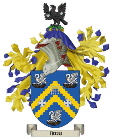
Reportedly a coat of arms was conferred upon Robert Ryves, courtier of King Henry VIII, in the first few years of the 16th century. The ancestral home of that Ryves family was Damory Court in Blandford, Dorset of the United Kingdom.

Eleven years into the 21st century, do we not all understand the absoluteness of DNA - that Y-chromosome DNA is inherited by male descendants unchanged except for occasional random mutations which occur over many generations? Surely there can be no question that with fourteen different groups or lineages identified by the Reeves DNA Project plus countless other Reeves individuals whose DNA does not fall into any of those groups, that only ONE of those lineages can descend from the Reeves or Ryves family of Dorset. It is categorically impossible for the descendants of a Reeves/Rives/Ryves male who lived in the 16th century to include multiple different DNA haplogroups and combinations of markers.


If we do all understand the scientific conclusions of DNA testing, then the obvious question looms - why do all the copious and completely different Reeves' family lineages continue to list Robert Ryves of Dorset on their pedigrees and websites? Are they uninformed, unintelligent or just otherwise misguided? Maybe not. The continuation of the practice of multiple Reeves' families linking to Robert Ryves as their ancestor appears to be simply that the desire to be descended from royalty supersedes intelligence, scientific fact, historical documentation and everything else.

The majority of the immigrants to the new world were certainly not wealthy or titled. They came for a myriad of reasons - religious freedom, as indentured servants seeking a chance to prosper in this new world or simply out of a desire for adventure. Prisoners of the British government were transported to the colonies as punishment for their political differences such as Scottish prisoners after their loss at the battle of Culloden.

Ironically, three hundred years after the first successful English settlement at Jamestown was established, most of the great estates and much of the English aristocracy, who were land rich but cash poor and whose income dwindled every year were seeking wealthy American brides. In the early part of the 20th century, the fabulously rich daughters of American billionaires such as Consuelo Vanderbilt traveled to England looking for a title and married into the cash strapped aristocracy. In 1895 alone, nine American heiresses married members of the English aristocracy, and by the end of the century a quarter of the House of Lords had a transatlantic connection.

American genealogy would benefit greatly if the descendants of the early colonists could begin to embrace the bravery and spirit of their less than royal ancestors. It took great courage to make the dangerous journey and endure the generally perilous living conditions of colonial America which should be admired and celebrated. The fact that they survived and prospered may have far more merit than a crest or a castle.